
Use cases
Spectra use cases
Six distinct NMR workflows Spectra assists — compound verification, dereplication, unknown identification, impurity hypotheses, natural products, and metabolites.
Spectra sits after acquisition and processing in TopSpin, Delta, or Mnova. Choose the analytical job that matches what is on your bench today: whether you are testing a proposed structure, screening an extract before isolation, or investigating unassigned peaks.
-
01
Known hypothesisNMR compound verification
Check whether submitted 1H and 13C data support a proposed structure before treating the assignment as closed.
-
02
Extracts & fractionsNMR dereplication
Separate known library scaffolds from genuinely new analogues before committing columns and instrument time.
-
03
Open-world searchUnknown compound identification
Produce a defensible shortlist when no structure is assumed, keeping shift residuals and unexplained signals visible.
-
04
Process & analyticalNMR impurity identification
Rank plausible explanations for unexpected signals beside a known major component without overclaiming confirmation.
-
05
Extracts & fractionsNatural-products research
Rank scaffold analogues and spot diagnostic 13C shifts in enriched fractions before isolation campaigns expand.
-
06
BiotransformationMetabolite identification
Rank metabolite and conjugate hypotheses from isolated or enriched NMR datasets with explicit residual uncertainty.
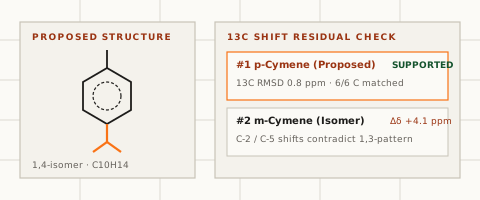
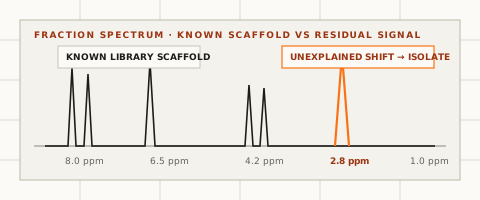
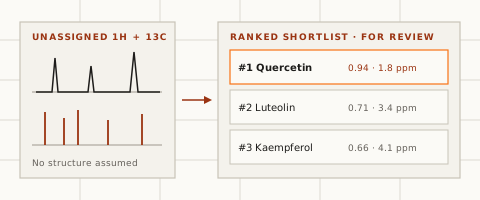
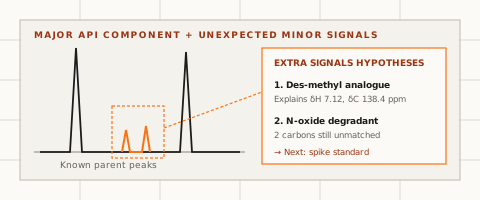
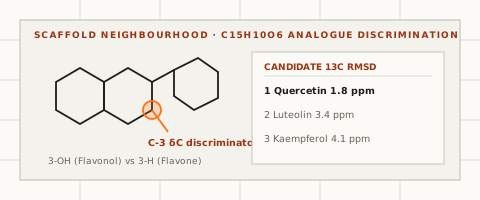
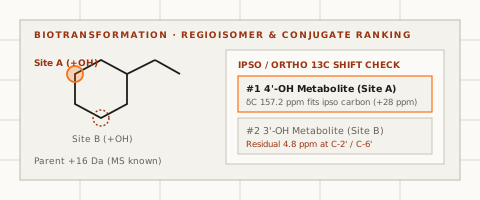
Inside the Spectra review interface
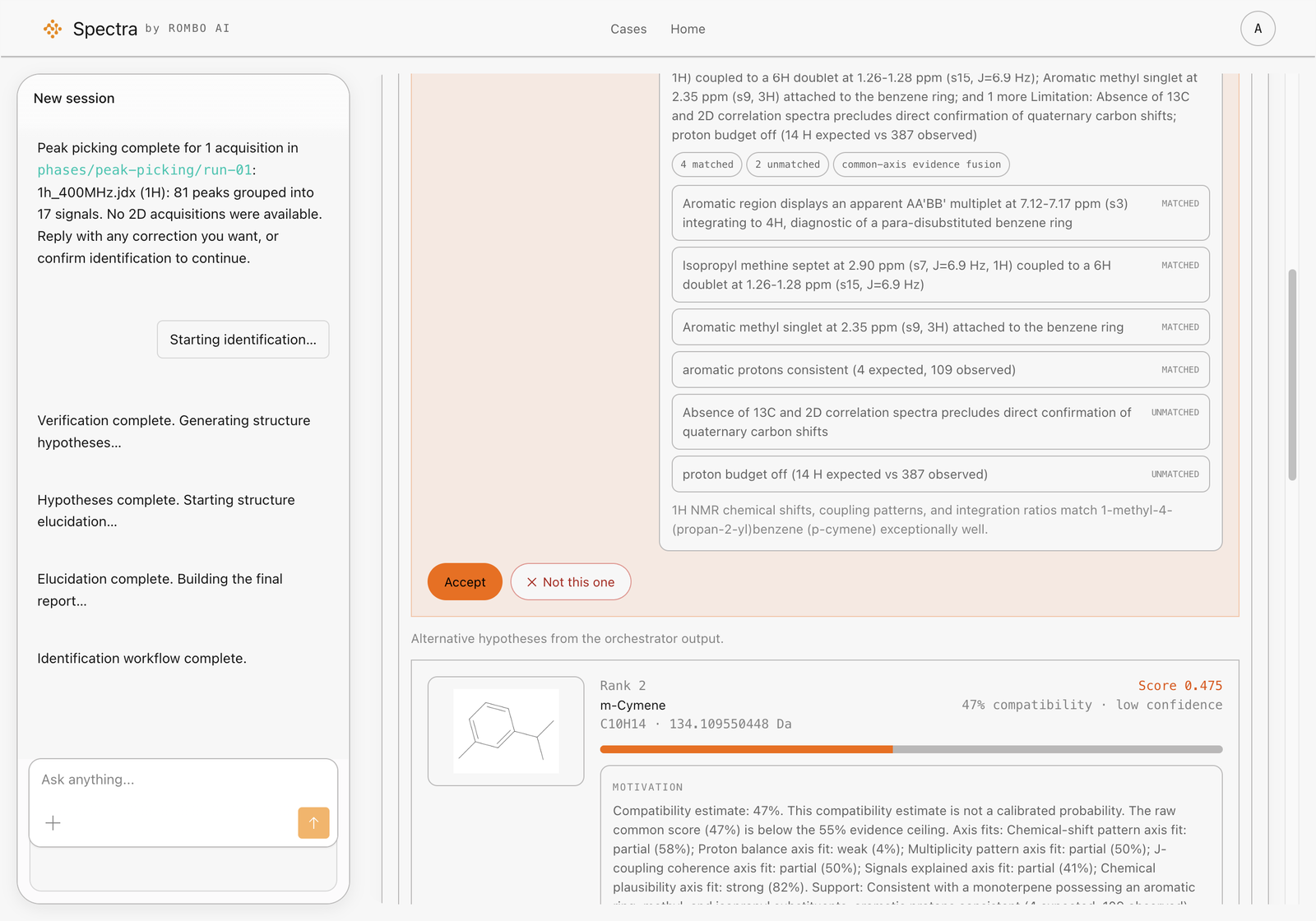
Every use case follows the same transparent progression: upload your 1H and 13C dataset with optional chemical context, inspect peak picking, and review ranked structure hypotheses with matched versus unmatched evidence.
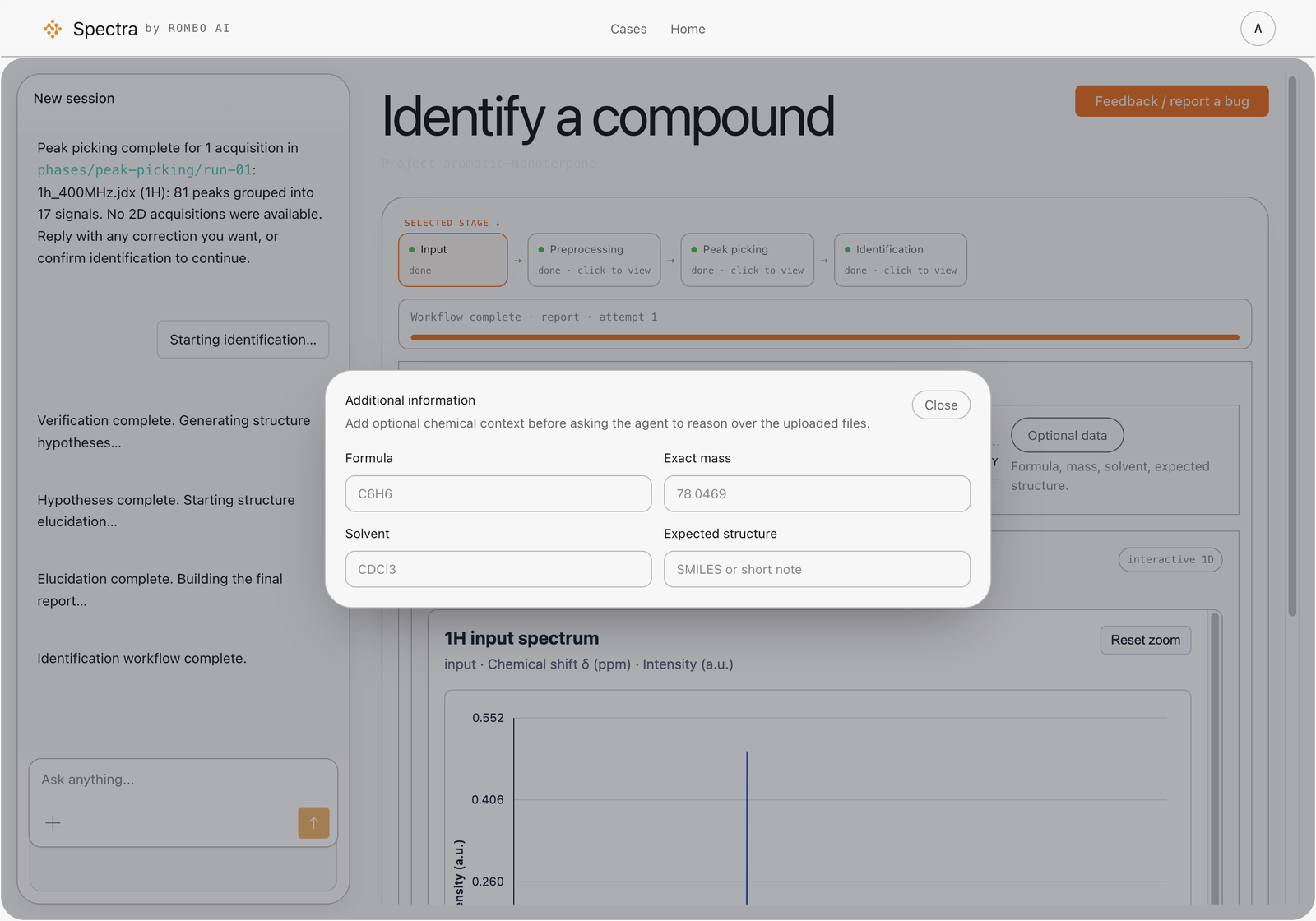
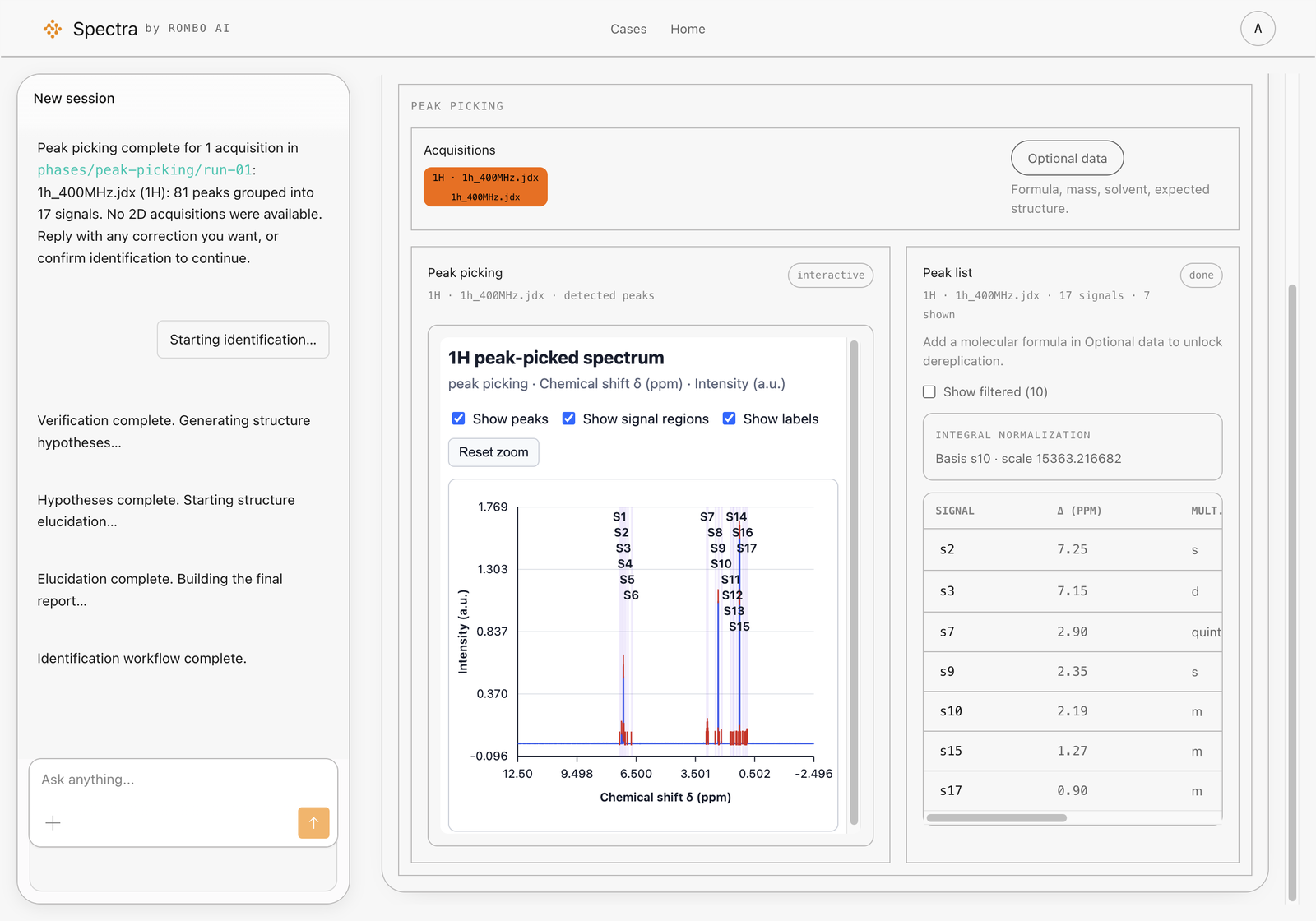
Choose by starting point
Not every NMR question starts with the same evidence. Use this table to pick the right workflow and see what Spectra expects.
| What you have in hand | Primary job | Minimum recommended NMR | What makes a run successful |
|---|---|---|---|
| A proposed structure from synthesis, vendor, or literature | Compound verification | 1H + 13C, solvent, field | Seeing whether the proposed structure ranks with low 13C residuals — or whether a close isomer still competes. |
| An unassigned sample with no assumed structure | Unknown identification | 1H + 13C (plus formula/MS when available) | Getting a reviewable shortlist — or flagging the sample as unknown when the data cannot separate candidates. |
| Unexpected minor peaks beside a known major component | Impurity identification | Mixture or enriched-cut 1H + 13C, known parent | Narrowing extra peaks to two or three chemically credible hypotheses to spike or isolate. |
| A crude or semi-pure extract with recurring signals | Dereplication | 1H at minimum; 13C on concentrated fractions | Stopping isolation early when a component matches a known scaffold with small shift residuals. |
| Enriched botanical, microbial, or marine fractions | Natural-products research | Fraction 1H + 13C, solvent, optional MS formula | Separating known scaffold members from analogues whose 13C shifts justify preparative chromatography. |
| Isolated or enriched metabolite from an incubation or biofluid | Metabolite identification | Enriched 1H + 13C, parent structure | Ranking phase I/II or endogenous candidates while keeping unexplained conjugate signals visible. |
By laboratory environment
If you are evaluating Spectra for a team or facility rather than a single spectrum, see how it fits your operating context:
01 / EXTRACT & ISOLATION TEAMS
Natural products and ingredient labs →
Dereplicate fractions before preparative isolation and focus column time on genuine structural novelty.
02 / CRO, CDMO & R&D ANALYTICAL
Analytical and contract labs →
Give reviewers a traceable first pass on structure verification and impurity hypotheses.
03 / SHARED INSTRUMENTATION
NMR core facilities →
Standardize the pre-consultation check across non-specialist users before they book staff time.