
Use case · Extracts & fractions
Natural-products NMR analogue ranking
Use 1H and 13C shift residuals to separate common natural-product scaffolds from novel analogues in enriched fractions.
- Starting point
- Enriched botanical, microbial, or marine fraction
- Typical input
- Fraction 1H and 13C, solvent (e.g. DMSO-d6, CD3OD), optional MS molecular formula
- Spectra output
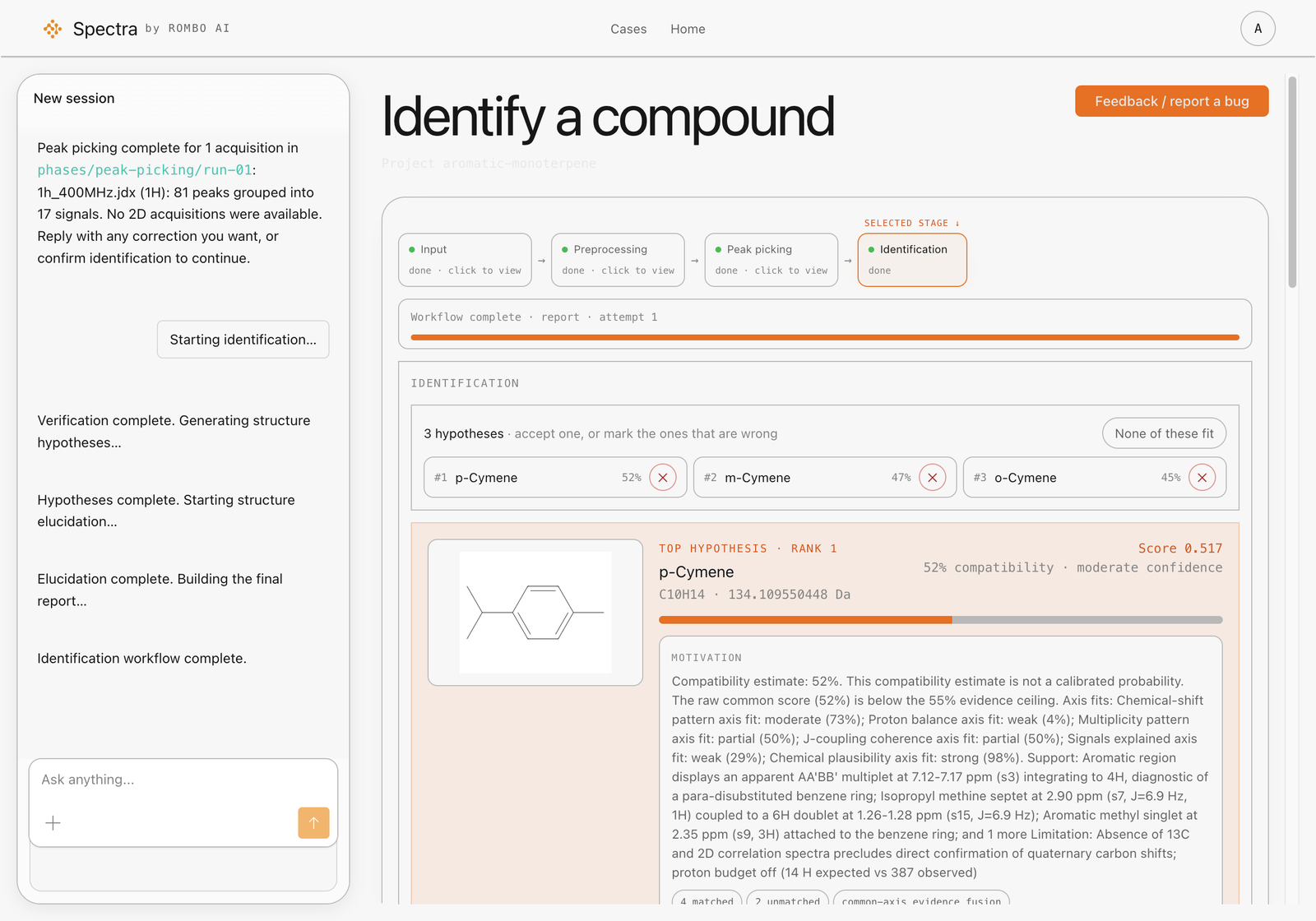
- Ranked scaffold candidates, diagnostic 13C shift comparisons, and unexplained peaks
- Chemist's call
- Set aside known scaffolds or isolate the fraction with novel shift residuals
The structural challenge in natural-products NMR
In botanical, microbial, and marine extracts, the peak of interest is rarely an alien ring system — it is much more often a positional isomer, deoxy analogue, or differently oxygenated cousin of a ubiquitous scaffold.
1H NMR alone frequently struggles to separate close natural-product analogues when aromatic doublets and oxygenated methines crowd the same window. Waiting until after full preparative purification to run a careful 13C comparison means columns and instrument slots get spent on compounds that a carbon residual check could have triaged earlier.
How Spectra handles scaffold neighbours
- Start from an enriched fraction with 1H and 13C — Export 1H and 13C from a concentrated fraction and include the solvent and any MS-derived molecular formula (such as
C15H10O6). - Compare the whole scaffold family at once — Rather than returning a single binary hit, Spectra ranks the competing members of the structural neighbourhood side by side.
- Pinpoint diagnostic carbon discriminators — Inspect the per-shift 13C residuals to see exactly which carbon atoms agree with the known parent and which carbon shifts signal a different substitution pattern (for example, C-3 oxygenation in flavones versus flavonols).
- Document the fraction decision — Record why a fraction was set aside as a known scaffold or promoted to full 2D (HSQC, HMBC, COSY, NOESY) elucidation.
Diagnostic example: separating C15H10O6 flavonoids
In the public walkthrough (CASE-2043), quercetin, luteolin, and kaempferol share the same molecular formula (C15H10O6) and similar aromatic spin systems in DMSO-d6. Spectra keeps all three on the shortlist (1.8 ppm, 3.4 ppm, and 4.1 ppm 13C RMSD) so the chemist can inspect the C-3 region that separates a flavone (luteolin, no 3-OH) from the two flavonols.
Related: NMR dereplication workflow, for natural-products and ingredient teams, ROSE 1H NMR research.
Scope & limitations
Where this workflow stops
Extensive glycosylation, rotameric equilibria, tautomerism, and heavy aromatic overlap in crude extracts will defeat single-compound ranking. Spectra assists NMR triage on enriched fractions; it does not replace chromatography or bioassay-guided fractionation.
Chemist sign-off
Recommended validation
Confirm dereplicated knowns against authentic standards when available, and restrict full 2D elucidation and preparative isolation to fractions whose 13C residuals survive that check.