
Use case · Process & analytical
NMR impurity identification
Rank plausible NMR explanations for unexpected signals beside a known major component, without treating the impurity as confirmed.
- Starting point
- Extra minor peaks beside an assigned API, intermediate, or product
- Typical input
- Mixture or enriched impurity-cut 1H and 13C, solvent, known major structure, process context
- Spectra output
- Ranked impurity hypotheses, 13C residuals, and signals still left unexplained
- Chemist's call
- Spike authentic standard, isolate enriched cut, or escalate to LC-MS
Who this job is for and why it stalls
Process-chemistry and impurity-characterization teams usually know the major component — the API, key intermediate, or formulated active — and need a chemically credible hypothesis for a set of unexpected minor peaks.
In practice, teams subtract the parent spectrum by eye, check residual solvent tables, and wait for LC-MS or preparative enrichment. Senior spectroscopists lose first-pass time chasing false leads from grease, rotamers, residual starting materials, or oxidative by-products before narrowing the discussion to the two or three structures worth synthesizing or spiking.
How the Spectra workflow runs
- Provide the enriched cut or mixture dataset — Upload 1H and (when impurity load or enrichment allows) 13C data, along with solvent and known process context such as reagents, oxidants, or parent structure.
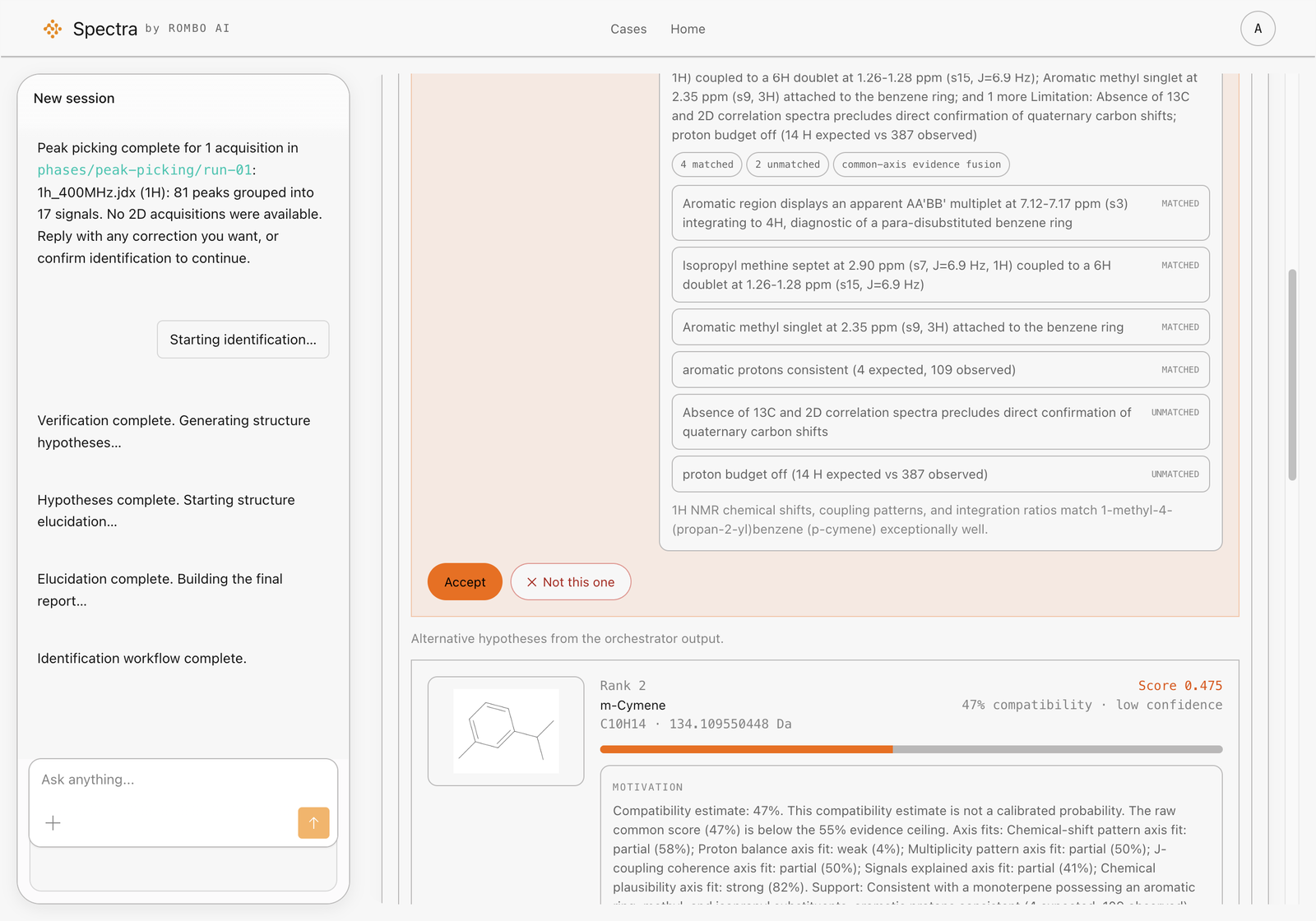
- Rank candidate explanations — Spectra retrieves candidate structures that could account for the extra spin systems and checks them against available 13C resonances to discard isomers the carbon data contradict.
- Separate parent, candidate, and leftover peaks — Inspect which signals are explained by the top-ranked impurity hypothesis and which resonances remain unassigned.
- Select the fastest confirmatory test — Use the shortlist to decide whether to spike a cheap commercial reagent/by-product standard or commission preparative isolation.
What to look for in the review
- A candidate explains all extra 1H/13C peaks with low residual: test immediately by spiking an authentic standard or checking retention time in LC-MS.
- Partial match with leftover signals: indicates either a co-eluting second impurity or a process degradant modified at a position not covered by the retrieved library member.
Related: analytical and contract labs, evidence and confidence, limitations.
Scope & limitations
Where this workflow stops
Low-level impurities often lack usable 13C signals, and Spectra will not invent a structure from three overlapping proton multiplets. Spectra does not apply ICH identification thresholds or replace a validated regulatory impurity method.
Chemist sign-off
Recommended validation
Confirm plausible candidates with orthogonal LC-MS, an enriched isolation cut, or a spiked authentic standard. Keep the accepted or rejected hypothesis recorded alongside the residual peaks.