
Analytical labs
A reviewable first pass for every structure question.
Verify proposed structures and rank impurity hypotheses from 1H and 13C data, with the evidence your reviewers need to agree or push back.
Email sales Analyze a spectrum free
Target user
CRO, CDMO and in-house analytical teams who verify proposed structures and chase unexpected signals beside a known major component.
Specific problem
The chemist who ranked the candidates is not always the chemist who signs the report. When the reasoning lives in a notebook, the next reviewer starts from zero.
Existing workflow
Process in TopSpin, Delta or Mnova. Predict, search a library, and write the discrepancy list by hand. Impurity work waits for enough 13C.
Where time is lost
Close analogues and isomers. Low-level impurities with three overlapping protons and no usable 13C. Re-explaining the same shortlist on the next shift.
How Spectra helps
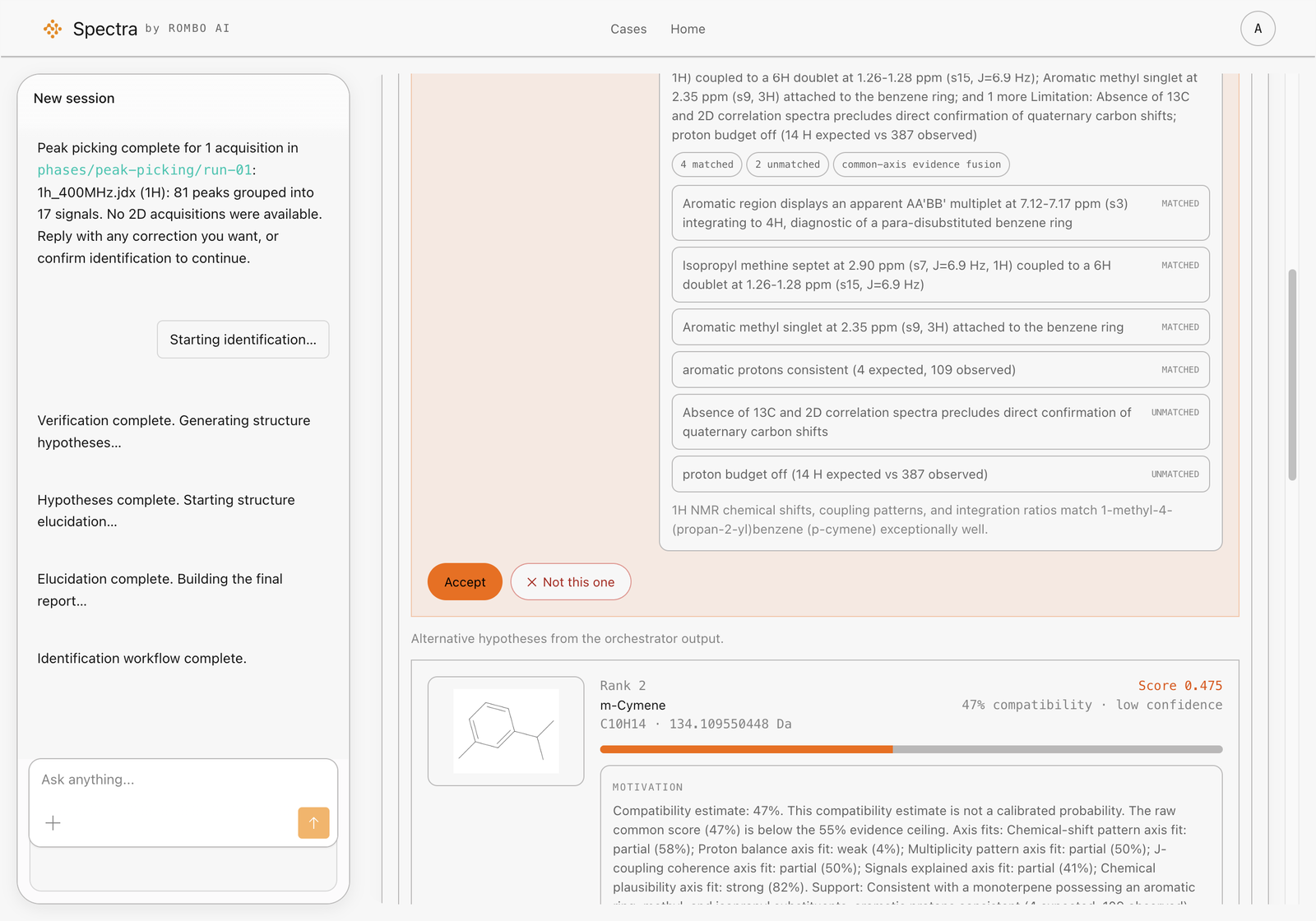
Spectra ranks proposed structures and impurity hypotheses from 1H and 13C, with match, 13C RMSD and per-shift residuals. Reviewers can agree or push back on the same evidence trail.
Data typically required
1H and 13C of the sample or enriched impurity; solvent and field; the proposed structure when this is verification.
Output
A ranked shortlist and the signals nothing explains — often the real impurity or a second component.
Limitations
Spectra will not construct a structure from three overlapping protons. It does not apply ICH identification thresholds or a validated impurity method. The chemist remains responsible for the report.
Recommended validation
Authentic overlay or a standard for the accepted structure. Escalate when residuals stay large or two analogues cannot be separated.
Bring a set of real identification problems from your lab. We run them through Spectra with you. Client spectra need data-processing terms before upload. See security.