
Documentation
Understanding results
How to read a Spectra identification — ranked structures, accept and reject, and an empty result that names the next experiment.
Identification publishes a ranking, or it publishes that no single structure is defensible. Both are results.
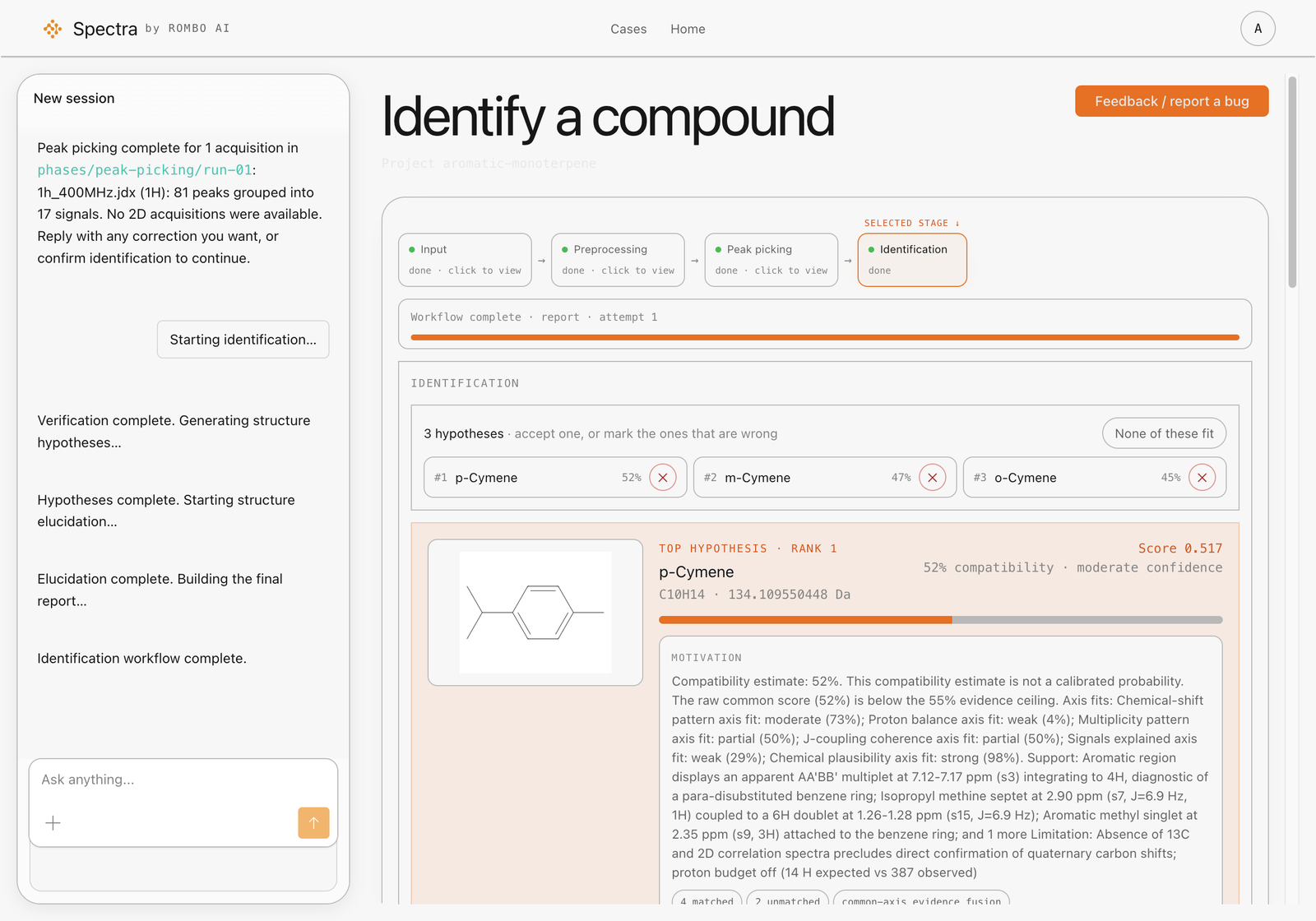
Ranked candidates
Each candidate is a concrete structure with a name, a formula when one is known, and the evidence that supports or limits it. Rank is the order in which to review those hypotheses. It is not a probability that the top row is the molecule.
Carbon evidence cites peaks that are actually in the spectrum. Two-dimensional evidence cites correlations from the HSQC, COSY, HMBC, TOCSY or NOESY you uploaded. A fragment or a motif is not offered as a finished structure.
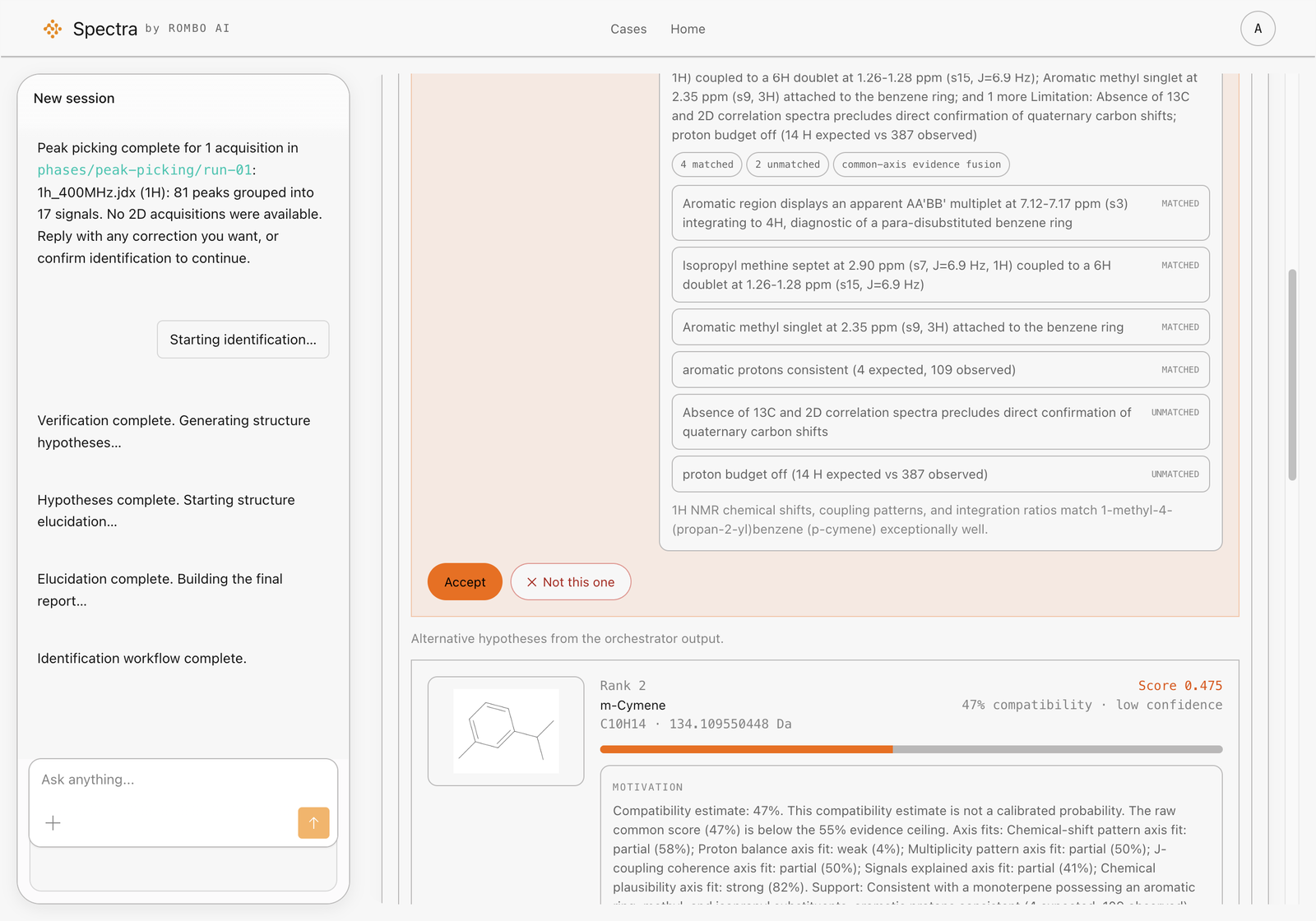
Accept or reject
When the ranking is complete, accept one candidate or reject it with a comment. Accept and reject stay unavailable while identification is still running.
Rejecting a candidate can start a new identification. The rejected structure and your comment stay with the project. A failed run is closed: the next attempt is a new run, not an edit of the failed one.
No defensible structure
If the data cannot support one structure — often 1H alone, without formula, mass, 13C or 2D — Spectra can finish with an empty ranking. The result names what is still unresolved and which measurement to run next. That is a completed identification, not a crash.
How to read a close call
Read match and residual error together when both are shown. A high match with a large 13C residual, or a mismatch on a distinctive carbon, is a reason to keep the analogue on the desk. Signals that no candidate explains are often the impurity, the second component, or the solvent.
What you keep
Keep the project, the files you uploaded, the accepted or rejected candidate, and your comment together. Spectra holds that review. It does not replace your LIMS or ELN.